For 20 Years, an Eagle Equipped With GPS Puzzled Scientists: The Mystery That Changed What We Know About Migration
For decades, scientists believed they understood how large birds migrated. Eagles, hawks, and other raptors were thought to follow predictable seasonal routes shaped by weather patterns, geography, and instinct passed down through generations. But one remarkable eagle challenged everything researchers thought they knew.
What began as a routine wildlife tracking project turned into one of the most fascinating scientific mysteries of modern conservation biology.
The Beginning of an Unusual Experiment
In the early 2000s, researchers working with the U.S. Geological Survey and several international conservation groups launched a project to track long-distance bird migration using emerging GPS technology.
At the time, satellite tracking was still relatively new. Scientists wanted to understand:
- How climate change affected migration
- Where birds stopped to rest
- Which habitats were most important for survival
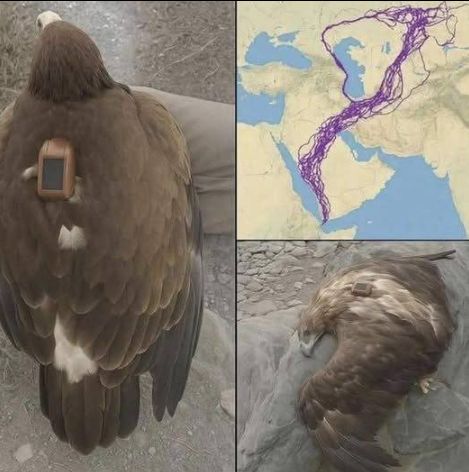
Among the many birds tagged was a young golden eagle captured in Alaska. Healthy, strong, and seemingly ordinary, the eagle was fitted with a lightweight solar-powered GPS transmitter and released back into the wild.
Researchers expected typical migration patterns.
Instead, they got twenty years of questions.
The First Strange Signals
The eagle’s first migration south appeared normal. Data showed steady movement across Canada into the western United States. But something unusual quickly emerged.
Unlike other tracked eagles:
- It avoided known migration corridors.
- It stopped in isolated areas with no obvious food sources.
- It repeatedly returned to one remote mountain region no other tracked eagle visited.
At first, scientists suspected equipment failure.
But the GPS signals were perfect.
Every location point confirmed the bird was deliberately choosing a different path.
A Pattern That Didn’t Make Sense
Over the next several years, researchers watched in fascination as the eagle repeated the same mysterious behavior.
Each autumn, it flew thousands of miles—but never in a straight line.
Instead, the bird traced a looping path that looked almost intentional, as if following invisible landmarks unknown to scientists.
Even more puzzling:
- The eagle sometimes paused for days in barren landscapes.
- It revisited specific cliffs and valleys with uncanny precision.
- It ignored areas rich in prey that other eagles depended on.
Scientists began asking an unsettling question:
Was this eagle discovering something humans didn’t understand?
Technology Reveals Hidden Clues
By the late 2000s, improved satellite imagery allowed researchers to compare GPS data with environmental conditions.
That’s when the mystery deepened.
The eagle’s stops aligned almost perfectly with thermal air currents—rising columns of warm air invisible to the human eye but crucial for soaring birds.
Instead of following geography, the eagle appeared to be following energy-efficient flight highways created by atmospheric physics.
In other words, the bird wasn’t lost.
It was optimizing travel better than scientists knew possible.
A Master of Energy Conservation
Raptors rely heavily on thermals to glide long distances without flapping their wings. Flapping consumes enormous energy, while soaring allows birds to travel thousands of miles with minimal effort.
But this eagle demonstrated something extraordinary:
It predicted where thermals would form days or even weeks in advance.
Researchers concluded the bird might be using:
- Subtle temperature shifts
- Wind pressure patterns
- Landscape memory accumulated over years
Its routes reduced energy expenditure far below previously recorded levels.
The eagle wasn’t behaving strangely—it was behaving brilliantly.
The Twenty-Year Record
Most tracking devices fail within a few years. Batteries die, birds disappear, or signals are lost.
Yet this eagle’s solar-powered transmitter continued sending data for nearly two decades.
Year after year, the same pattern repeated:
- Northern breeding grounds
- A sweeping arc across remote terrain
- Strategic rest points
- Precise seasonal timing
Scientists realized they were witnessing one of the longest continuous wildlife tracking records ever collected.
And with each migration, the eagle refined its route slightly—suggesting learning and adaptation.
What Scientists Learned
The project reshaped understanding of animal intelligence and migration.
Researchers discovered that migration is not purely instinctual. Instead, experienced birds appear to improve routes over time, almost like pilots optimizing flight paths.
Key discoveries included:
- Eagles remember successful flight routes for decades.
- Atmospheric conditions influence migration more than geography alone.
- Individual animals can develop unique strategies unknown to their species.
The findings influenced conservation planning worldwide.
Protecting migration corridors now meant protecting airspace conditions, not just land habitats.
Conservation Implications
As wind farms, climate shifts, and urban expansion altered landscapes, scientists realized birds might lose access to the thermals they depended on.
The eagle’s data helped conservationists identify previously unknown “sky highways.”
These invisible routes became critical to wildlife protection strategies led by organizations such as the National Audubon Society.
Instead of focusing only on nesting sites, conservationists began advocating for:
- Smarter wind turbine placement
- Preservation of open thermal zones
- Reduced disturbance along key migration paths
One eagle had rewritten conservation priorities.
The Final Transmission
After nearly twenty years, the GPS signal finally stopped.
There was no dramatic ending—no distress signal or confirmed location. The transmitter simply went silent somewhere along its familiar migration route.
Scientists believe the eagle likely died of natural causes, having lived an unusually long life for a wild raptor.
Yet its legacy remains extraordinary.
A Reminder of Nature’s Intelligence
The eagle’s story challenged a long-held assumption: humans do not fully understand the natural world, even when equipped with advanced technology.
Despite satellites, algorithms, and decades of research, a single bird revealed complexities scientists had overlooked.
It demonstrated that:
- Animals can learn and innovate.
- Migration is dynamic, not fixed.
- Nature still holds secrets waiting to be discovered.
Today, modern tracking projects continue using lessons learned from that pioneering eagle, helping researchers protect species across continents.
And somewhere high above mountains and oceans, countless birds still ride invisible rivers of air—guided by instincts refined through experience, memory, and survival.
For twenty years, one eagle puzzled scientists.
In the end, it didn’t just solve a mystery.
It changed how humanity understands life in the skies.